An article entitled “Nuclear Urbanity as Heritage” by Dr. Linara Dovydaitytė, Associate Professor in the Department of Art History and researcher at the V. Kavolis Transdisciplinary Research Institute, and Oksana Denisenko, alumna of the Faculty of Arts, has been published in Urban History, a prestigious Q1 journal published by Cambridge University Press. The article analyses nuclear urbanism — a unique variant of industrial city planning, spatial organisation, and social dynamics — from the perspective of cultural heritage. It examines nuclear urbanism, a distinctive form of industrial city planning, spatial organisation, and social dynamics, from the perspective of cultural heritage.
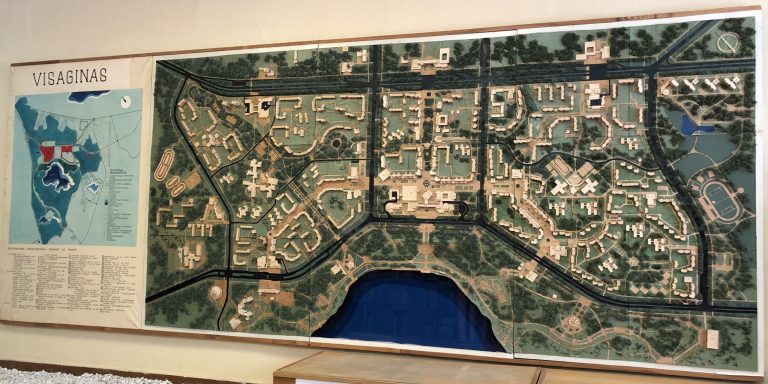
The study revealed that Soviet industrial urbanisation also functioned as a unique form of heritage, intertwining different concepts of time, propaganda objectives and preservation practices. The history of the memorialisation of Visaginas (formerly Sniečkus), which was chosen for the study and is dedicated to the employees of the Ignalina Nuclear Power Plant, shows that despite its standardised architecture, the new city, which was built from scratch, was perceived from the very beginning as an urban creation worthy of commemoration. According to L. Dovydaitytė, even while construction was still underway, efforts were already being made to turn the city into a museum, with new residents being invited to record and collect stories about the city under construction for future generations.
Early memorialisation practices helped various groups of residents, including specialists who had come to the Ignalina Nuclear Power Plant from across the Soviet Union, local authorities and cultural figures, to form new communities and negotiate the city’s identity. However, during a period of political change, the legacy of nuclear urbanism became discordant, revealing the colonial nature of the project and prompting a rethink of the professional and ethnic identities of the city’s inhabitants. Over the past decade, the decommissioning of the Ignalina Nuclear Power Plant has led to a shared belief that the nuclear past can be used to regenerate the local area. New stakeholders are now embracing this history to promote economic development and tourism.
The results of the study presented in this article challenge the established view in contemporary critical heritage studies, which places particular value on heritage created and transmitted by authentic local communities. The case of Visaginas, an example of nuclear colonialism urbanism, reveals that, in the context of nuclear energy, the concept of community is neither self-evident nor stable. It also shows that the creation of heritage can facilitate the formation of new communities, the negotiation of local identity and the planning of the future.
This publication makes a significant contribution to international studies of industrial heritage, in which cultural assessments of industrial cities typically occur alongside deindustrialisation. Unlike in Western countries, the Soviet Union exhibited a tendency towards ‘presentism’ in heritage, encouraging the consideration of new architecture as heritage due to its ‘Sovietness’ rather than its age or uniqueness. The article demonstrates that, in the case of Visaginas, this approach to heritage left behind a lasting structure of social memory and urban imagery, enabling the city’s past to be readily adapted to contemporary requirements. However, today, the cultural reinterpretation of Visaginas remains framed as an exceptional project of nuclear urbanism surrounded by nature, with more complex issues such as ethnic tensions or environmental consequences often being overlooked.
This article was prepared as part of the international project ‘Nuclear Spaces: Communities, Materialities, and Places of Atomic Cultural Heritage’ (2021–2024), with the support of the Lithuanian Council for Science (LMTLT) under contract no. S-JPIKP-21-1. You can find out more about the project here: https://nuspaces.eu/